Showing posts with label 20mph. Show all posts

Tuesday, 10 September 2013

Open Response to Notting Hill Gate redevelopment consultation

Kensington and Chelsea are currently consulting on a redevelopment of Notting Hill Gate. The consultation itself is available here. 

I would urge everyone to respond to this consultation individually and let the council know this is the perfect opportunity to develop ground-breaking improvements in cycling and walking in the area.

My open response:
Notting Hill Gate is currently a major barrier for cycling in the borough, and London as a whole. The entire junction is horrible; an essentially 1970s design that encourages large volumes of traffic motor to move through the area at dangerously high speeds, leading to pedestrian and cycling fatalities and actively suppressed rates of walking and cycling. 
Visitors to the area can still see a white bike with flowers in memory of Eilidh Cairns who was tragically and wholly unnecessarily killed in Notting Hill Gate by a lorry driver in 2009. It is right that this 'ghost bike' remains near the spot where she was killed, both in memory to Eilidh and to remind the Council that something desperately needs to be done to prevent more wholly avoidable deaths occurring here.

Additionally, the entire area has illegal levels of air pollution and nitrogen dioxide levels that rival Beijing. In fact, a specific stretch of Notting Hill Gate is one of the most polluted streets in London.

The easiest way to solve both these problems is to radically redesign the entire area to provide safe, segregated cycle routes through Notting Hill including bus stop by-passes for cycling. When this has been done in New York it has led to an over 50% rise in local spending, as areas were transformed into 'people places', rather than motor traffic hell. Notting Hill Gate would also benefit from more, and easier pedestrian crossings (including zebra crossings), and a 20 mph limit.

The Westway is less than a mile north and provides a quick, direct route for motor traffic into Central London. There is no reason, therefore, why Notting Hill Gate should not be re-thought and re-designed as an area that prioritised cyclists and pedestrians (if only because these people don't use vehicles that emit illegal levels of air pollution which lowers everyone in the area's life expectancy.

One of the council's core aims is to encourage alternative transport to private car use, such as cycling and walking. The council would be ignoring and actively refuting its core aims if it did not, therefore, use this opportunity to transform Notting Hill Gate into somewhere where walking and cycling is actively encouraged, rather than discouraged, as it is by the current street layout.

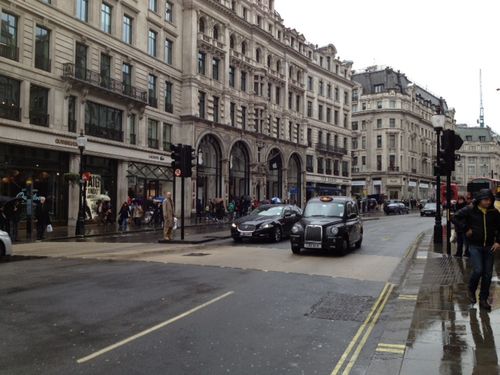
Notting Hill Gate. Can you see anywhere safe to cycle through here? Can you see anywhere safe to cross the road as a pedestrian? This junction needs to be completely redesigned with wide segregated cycle lanes, bus stop by-passes for cycling, and more pedestrian crossings.

Wednesday, 7 August 2013

Easy to use definitions of "Cycle Superhighway" and "Quietway" for Andrew Gilligan, TfL, and local council officials

At the City of London Cycling Forum last month the City officials told us that they had already had a few meetings with Andrew Gilligan, but that these meetings had not been spent discussing any actual cycle lanes. Instead, they had used the time to discuss the definition of the words "Cycle Superhighway" and "Quietway" (which are used in the Mayor's Cycling Vision). It's great to know that our public officials are spending their time so efficiently, but I thought I'd try and make their lives even easier by defining these words myself.

Cycle Superhighway = completely physically separated from motor traffic + wide enough to accommodate the amount of Londoners who would want to use it.

(Using this definition Cycle Superhighway 2 is not a 'Cycle Superhighway' because it is not segregated from motor traffic; which helps explain why 3 people have been killed on it. Nor is the segregated track on Tavistock Place a 'Cycle Superhighway' because it is too narrow to easily contain all those that seek to use it, making it often dangerously busy.)

Quietway = a well-surfaced road with no through-traffic + a 20mph speed limit.

(Using this definition there would be a few 'Quietways' currently existing in Hackney and Islington, but somewhere like Soho which has through-traffic hurtling through narrow one-way systems at 30mph would be anything but a 'Quietway'.)

I know these definitions are somewhat stringent, but they could be used as a template for those at TfL and local councils trying to design and build cycle routes. The relative quality of a Quietway or Cycle Superhighway could be extremely quickly measured by looking at how much of it's route matched up to the two simple criteria.

Cycle campaigners could then use these definitions very effectively to criticise deficient parts of a proposed or build cycle route. One could say for instance that, "this Cycle Superhighway is nothing of the sort because only 50m of it is segregated", or, "this Quietway isn't fit for purpose because most of it contains fast-moving, dangerous through traffic that isn't capped by a 20mph limit. I'd be mad to let my child cycle to school along this route unless the through-traffic was removed and a 20mph limit put in place".

It's not that all roads in London need to be designed along the aforementioned guidelines, but that a route is simply not 'quiet', in any sense of the word, if there are taxis constantly rat-running it at 30mph. It's just a road with a sign on it. Similarly a route is not a 'cycle superhighway' if you're sharing a motor-traffic lane with HGVs. It's just a road with some blue paint on it.


Sunday, 30 June 2013

20mph limit for the City of London. Next step, borough-wide 20mph for Westminster. Step after that, 20mph limit for London

A 20mph borough-wide limit on all roads in the City of London has almost passed all the councils it needs to in order to become law. (Quite exciting and something long campaigned for by blogs like Cyclists in the City).

The new normal for the City of London. Photo courtesy of The Londonist.
You can read a rather excellent report by Philip Everett (Director of the Built Environment) and Craig Stansfield (Team Leader, Transportation Strategy and Programmes) here. Much of the report deserves quoting, but I've selected the best bits to make your life easier:
There has been a dramatic rise in the numbers of cyclists and pedestrians, and with the advent of Crossrail increasing the number of pedestrians and the encouragement of cycling generally, these numbers can only increase. Compared with the rest of London, in the City these groups are disproportionately highly represented in the casualty statistics. The situation can therefore only get worse unless we do something different. (p.1)
In response to this the City predicts that a borough-wide 20mph limit would lead to,
predicted casualty savings of between 8–9%, i.e., around 30–40 casualties per annum. (p.1)
 The City then notes that:
The often-quoted low average speeds within the City mask both streets where average speeds are over 20mph and also peak traffic speeds at various times such as evenings and weekends. Secondary benefits such as reduced pollution and health improvements through modal shift to cycling are likely to occur. (p.2)
And:
There is little or no disbenefit to introducing a 20mph speed limit and in particular journey-time increases would be minimal given the size of the City. (p.2)
They also supply this interesting local example of a 20mph limit leading casualties to drop from nine to nil:
Several years ago, Transport for London introduced a 20mph limit on Upper Thames Street between Swan Lane and Queen Street to facilitate the refurbishment of Walbrook Wharf. There was a dramatic reduction in casualties. The three-year casualty total before the speed-limit reduction was nine and the total for the three years of the 20mph limit was nil. (p.5)
Finally, the City notes a 20mph limit would be in line with national and international best practice since:
All boroughs surrounding the City, with the exception of the City of Westminster, have adopted 20mph for all, or most, of their area. (p.7)
And...
Internationally, New York, Paris and Tokyo have, or plan to, introduce substantial speed-reduction initiatives in at least part of those cities. (p.7)
This really is fantastic news for all those cycling in through the City and follows hot on the heels of Islington becoming the first borough to officially go 20mph!

Photo courtesy of BolgarB on Twitter.
There's more good news too: Boris Johnson's Environment Advisor, Isabel Dedring, has come out as a strong supporter of a London-wide 20mph limit. She said in June 2013 that:
[A London-wide 20mph limit] could be realistic by 2020. It could be one of these things like smoking (in public places) where suddenly we get to the stage where we can’t believe it would ever have been OK to drive above 20mph.
20mph borough-wide limits brings a whole series of advantages to a neighbourhood:
Obviously what we really want is proper cycle infrastructure, including wide, continuous, segregated cycle lanes on busy roads. However, 20mph limits shouldn't be sniffed at by cycle campaigners.

20mph zones can bring real benefits, particularly during off-peak times when motorists on empty streets will regularly pass you at 30, 40, or even 50mph. Moreover, they transform a dangerous pass at 30mph from something almost 'expected' or even 'required' of a motorist (since it's easily possible to fail a driving test for going too slowly or not 'driving to the limit') into something illegal (even if enforcement is often difficult). This means if a motorist recklessly hits a cyclist or pedestrian at 30mph and kills them it's much easier to prosecute the driver for their (now) illegal actions. This in turn will lead to safer and more responsible driving by motorists.

30mph 'shopping' streets: dangerous, polluted, and uninviting. Bad for business too.
A 20mph limit also sends out a wider message to those using cars which is that the safety of cyclists and pedestrians is being prioritised over and above that of journey times for motorists. Ultimately, this message needs to sink in and be accepted by the wider non-cycling majority in order to for politicians to feel there are 'votes' in giving over more road-space to cycle-only lanes.

A 20mph borough-wide limit is not a bad place to start. It tells everyone this is a borough where pedestrian safety and cycle safety is the number one priority. From here, it is surely easier to start reallocating parking spaces or traffic lanes into segregated cycle tracks.

However, it is disappointing that many councils still oppose borough-wide 20mph limits. As the City of London document notes, Westminster Council is the only council bordering the City that continues to do so. This is especially disappointing given that the City's remarks on Crossrail, long-term increase in cyclists, and comparatively high casualty rates, apply even more firmly to Westminster than they do to the Square Mile:
There has been a dramatic rise in the numbers of cyclists and pedestrians, and with the advent of Crossrail increasing the number of pedestrians and the encouragement of cycling generally, these numbers can only increase. Compared with the rest of London, in the City these groups are disproportionately highly represented in the casualty statistics. The situation can therefore only get worse unless we do something different. [Westminster is the London Council with the highest number of pedestrian and cyclist casualties.]
 (p.1)
Furthermore, in March 2013 Westminster Council itself released data showing that two thirds of crashes (68%) between cyclists and motorists were the fault of the driver. Yet, disappointingly Westminster Council is still opposing a borough-wide 20mph limit even on boundary streets with Camden!

This is very sad, especially given that since so many roads in London are single-lane, 20mph limits are by and large self-enforcing, because it only takes one driver to drive at 20mph to slow the whole traffic flow down.

Councils, like Westminster, which claim 20mph limits are a waste of money because they cannot be enforced are using the line as a false, weasel argument to conceal their real reason for opposition. They just want to be able to drive at 30mph whether or not this leads to tragically high numbers of road casualties.

The simple fact is that every part of UK that has seen 20mph limits installed has also seen a significant drop in casualties and significant drop in maximum speeds (here's an example from DfT of un-enforced limits leading to a reduction in casulties in Portsmouth), which puts paid to the fatuous idea, still ignorantly propagated by Councils like Westminster and Kensington & Chelsea, that 20mph limits are somehow 'useless'. Though 20mph zones are always more effective when accompanied by strict enforcement and traffic calming measures (which don't -  as many do - create dangerous pinch points between cyclists and motorised traffic), a 20mph limit unaccompanied by these measures is still a significant improvement for everyone using that street.

Moreover, as the City of London's report highlights, areas like Westminster are in real danger of falling behing their international competition in New York and Tokyo by refusing to humanise and tame their dangerous roads through the creation of a borough-wide 20mph limit. Westminster has even refused to make Oxford Street 20mph, despite the fact it receives over-200 million annual pedestrian visitors. Shocking...

When is it ever safe to drive down Oxford Street at 30mph? So why is it still legal to do that?
If we want London to become a 20mph city we need to make our voices heard in support this policy; the best place to start is with your local borough. Bit by bit we can do it.

And, if you do get in touch with your local politicians, make sure you don't accept any of this crap about un-enforced or lightly enforced limits being 'useless' or 'a waste of money'!

Thursday, 27 June 2013

Cycling is now the dominant mode of travel on Central London's roads, yet still idiotically ignored by Westminster Council in new Bayswater plans.

The Evening Standard published an article a few days ago with some rather stunning figures about bike travel in London:
  • On Theobald's Road 64% of vehicles in the morning peak are bikes.
  • On Kennington Park Road 57% of vehicles in the morning peak are bikes.
  • On Old Street 49% of vehicles in morning peak are bikes.
  • In Central London 24% of all traffic are bikes during the morning peak; 16% acros the whole day.
  • On Blackfriars, Waterloo and London bridges cyclists make up 42% of traffic and 15% of people, though they take up only 12% of road space
  • By contrast: taxis on Oxford Street take up 37% of road space but only carry 1% of passengers!
As Andrew Gilligan says "These extraordinary figures disprove any claim that cycling is marginal and that investing in it is indulgent." I believe it's importnat to make that clear, especially to members of the general public that may not cycle themselves. In fact, I think Gilligan's approach of securing approval for his £1 billion cycle plan by stressing the benefits to those that don't cycle is extremely intelligent.

Cycling is important. Those that choose to travel by bike not only help the environment and reduce road congestion, they also work all manner of jobs and contribute significantly to London's (and Britain's) GDP.

This idea that only those that drive actually have jobs, and so to promote economic growth we need to build more roads, is absolutely crap, as Evening Standard's latest figures show.

These guys are clearly adding nothing to London's economy.... Photo from Standard article.
If we want London to grow economically we need to make its workforce safer. Therefore, since 24% of all vehicles during the morning peak are bikes, we logically need to make those that choose to cycle safer.

And yet cycling is still being designed out of London's roads by awful new schemes such as Westminster Council's proposals for the Bayswater area.

These plans are, frankly, atrocious. Cycle parking is being removed since it is 'clutter' (yes, 'clutter'!). Car parking spaces will be increased leading to more congestion, more fumes, more noise, more road traffic accidents, and more road traffic deaths.

Photo from PDF of Westminster's proposed 'improvements'.

You can see in the photo of the proposed 'improvements' for Queensway North a couple of things:
  • No cycle lanes of any kind. This is simply idiotic. Plenty of space for segregated lanes in each direction on this Queensway.
  • Cyclists positioned in a 'death zone' between opening car doors from stationary vehicles and oncoming taxis and private cars that are driving dangerously close to them. The Highway Code, by contrast, states motorists should "give cyclists at least as much room as you would when overtaking a car".

Notice a difference between this photo (courtesy of The Highway Code) and the last one?
Moreover, these plans are also bad economics. Westminster Council note that "Queensway is a busy shopping street at the heart of Bayswater." They want to improve its qualities as "a shopping and leisure destination". Yet, in their efforts to achieve this Westminster Council are pretending they're in the 1970s, lagging embarrassingly far behind New York City's Department for Transport that has long recognised the economic benefits that increased cycle traffic brings:

Photo courtesy NYC Department of Transportation. The figures speak for themselves.

Westminster Council may not be much bothered about achieving a 58% decrease in injuries to all street users. Perhaps they aren't... That's very sad if it's the case....

But, if they want to be "encouraging people to stay and use the streets shops and eateries" in Bayswater they might just take note of the 49% increase in retail sales. (Yes, 49%!)

What is shocking about these plans is not just that they demonstrate little or no concern for preventing traffic accidents and deaths, but they are also bad, bad economics.

Westminster Council have also tried to contextualise their improvements within the surrounding area, but again they are dangerously off-track.

Map from consultation document showing Bayswater and surrounding areas.

There are a few crucial bits of information left off this map:


    Therefore, there might be a significant commercial advantage to be gained if a safe cycle network were created linking Portobello, Westbourne Grove, Paddington, Hyde Park, and of course, Bayswater.

    But are Westminster at all interested in this? No. 

    Are they even aware of the potentially enormous economic benefits to be had if tourists on Boris Bikes could be lured out of Hyde Park to spend money in Bayswater? No.

    Are Westminster Council even considering that most token of gestures to make pedestrians and cyclists safer, something that the City of London recently wrote had "little or no disbenefit", a 20mph speed limit? No, no chance (at present...). 

    Do they want their pedestrians and cyclists to be safer? Not if it slows down motor traffic...

    We are left with: more car parking; more motor cars; more road traffic accidents and deaths.

    That's all we're getting in Bayswater, despite the fact 24% of morning peak vehicles are now bicycles. Appalling.

    But something can be done - if you take a similar view to these plans then please:


    The feedback form includes a specific section "cycle parking and provision", so it's well worth filling in. Perhaps these plans can be improved on. I certainly hope so.

    B) Write an email suggesting that cycle lanes and a 20mph zone (among other improvements for cyclists such as more cycle parking) could be very profitably integrated into the Bayswater plans to:

    Councillor Edward Argar
    Cabinet Member for City Management, Transport and the Environment
    Westminster City Council

    Since Councillor Argar is also Cabinet Member for 'the Environment' there should be an added incentive for him to embrace cycle and pedestrian safety by promoting cycling as an environmentally friendly form of travel...

    Plenty of space on Queensway for proper segregated cycle lanes like this example from Montreal, Canada. Trouble is, Westminster won't build them... Image courtesy of StreetsBlog.org

    Saturday, 1 June 2013

    Road Narrowing is engineering our roads to be even more dangerous than they already are for those on bicycles

    This evening Mark Ames (of ibikelondon) tweeted:
    "Got honked at by angry cabbie for taking lane on narrowed bit of Bethnal Grn Rd where cyclist was killed recently. HATE road narrowing!"
    Martin Porter QC replied:
    "@markbikeslondon Blame the cabbie first and foremost - road layout is intended to slow him down."
    Now, I can't speak for my readers, but I have an extremely big problem with this attitude, especially when it comes from someone else who cycles. Effectively, 'blaming the cabbie' means that we are simultaneously accepting that cyclists should be used as human traffic calming devices, and that this is somehow okay.

    It's not okay.


    Cheapside, City of London (courtesy of Cyclists in the City). A dangerously close over-take is happening. Who's at fault? I would argue the road design itself, which is bringing the cyclist and van into active conflict. Plenty of room here for a segregated cycle lane...

    It is not okay for local authorities to slow down taxi drivers (and all other forms of traffic) by narrowing roads to create danger zones where cyclists and motorised traffic are actively brought into each other's paths. When local authorities use narrow sections of road to slow traffic they are deliberately bringing cyclists and drivers in active conflict with each other.

    To speak bluntly, it is completely infeasible to imagine that we could somehow persuade the majority of motorists to be happy with a cyclist pootling along at 10mph or less in the middle of the lane in front of them. To do so is to attempt to use said cyclist as a human traffic calmer. This is extremely dangerous and leads to cycling fatalities. It is inhumane.

    If councils want to slow traffic down it is very simple, easy and effective to introduce a 20mph limit and segregated cycle lanes which lead to a reduced width traffic lanes. These rather excellent plans for Manchester provide a case in point:


    Or we could turn to Tavistock Place in Camden, where the council chose to narrow the traffic lane widths while providing a separate segregated lane for cyclists which is (surprise, surprise) incredibly popular:

    Happy pedestrians, happy cyclists, happy motorists. No pinch points, no idiocy from the local council. Tavistock Place, Camden 5/6/2013
    Cyclists love segregation. Simple.
    For a full history of how much wider this track could have been if it were not for (ignorant) local opposition to segregated cycle tracks, please see this highly informative post by Vole O'Speed.

    What is remarkable about this stretch of segregated cycle tracks at Tavistock Place is that even though it is sub-standard and far too narrow, it is still extremely well used, conclusively demonstrating that even sub-standard segregation is better than mixing cyclists and motor traffic. This example from Holland shows the correct width (at least 2m) that councils should be aiming for:

    I very much hope the East-West 'Crossrail for bikes' will be of this standard. Wide, easy and safe. Holland gets it right again. Image courtesy of AsEasyAsRidingABike.